Default to yes: the Productivity Commission’s housing verdict, and the piece that still gets missed
Back to Blog 31 July 2026 5 minute read
The Productivity Commission has handed down its interim report on housing supply regulation, and the direction is clear. Regulators should default to yes. Commission Chair Danielle Wood says it boggles her mind that rules are preventing homes from being built in the very places people want to live and work. Paul Waterhouse, acting chief executive of Urban Taskforce Australia, called it the right note, and he is right.
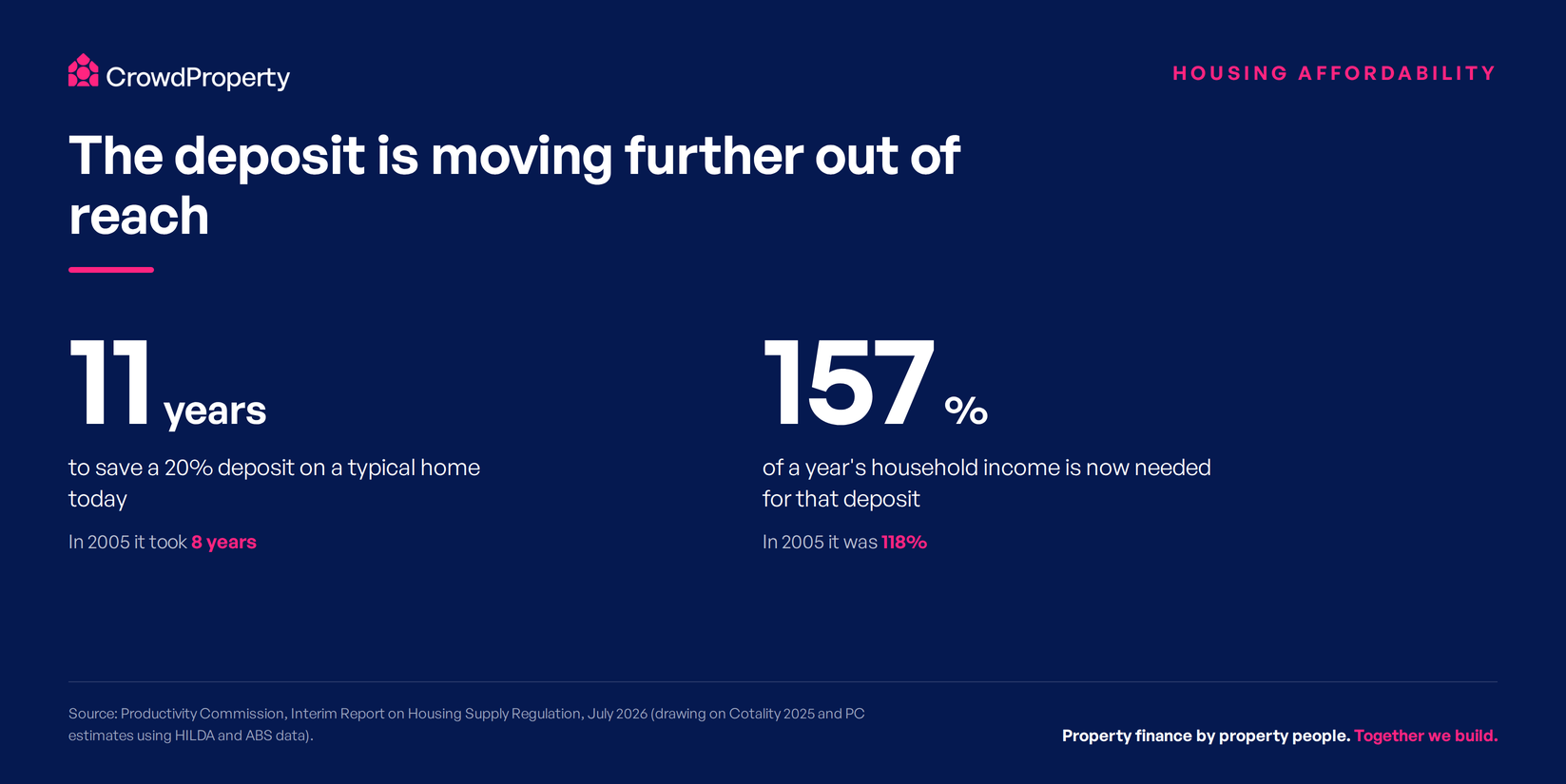
This is a serious piece of work with a simple diagnosis. We are not building enough homes where people actually want them, and affordability is paying for it. It now takes the average household 11 years to save a 20% deposit on a typical home. Twenty years ago it took 8. That deposit is now worth more than 18 months of household income. Home ownership among 25 to 34 year olds has fallen by around 17 percentage points since the early 1980s. None of this is news to anyone trying to buy or build. What is useful is that a body like the Commission has put numbers and priorities around it.
What the Commission found
The report ranks its reform areas rather than treating them as equal, which matters. Land-use reform to allow more density in the places people want to live is judged to have the greatest effect on supply. Fixing how infrastructure is planned and paid for comes next. Faster approvals help, but the Commission is honest that approvals reform alone will not close the gap.
| Theme | What the Commission found | Why it matters for developers |
|---|---|---|
| Affordability | 11 years to save a 20% deposit today, up from 8 in 2005. That deposit is now around 157% of a year’s household income, up from 118% | Demand for well-located, feasible homes is not the problem. Supply is |
| The supply gap | The National Housing Accord targets 1.2 million homes by 2029. Current forecasts undershoot by 220,000 or more | The shortfall is a pipeline of projects waiting to be made feasible and funded |
| Land-use controls | The single biggest lever on supply. 75% or more of residential land in Brisbane, Sydney, Perth and Adelaide is zoned for just one or two storeys | Zoned capacity is being held back before a project even reaches feasibility |
| Upzoning potential | Modelling suggests lifting Sydney heights to four storeys could add 210,000 dwellings, removing maximum floor-space ratios another 140,000 feasible homes, and Melbourne activity-centre changes 100,000 | Sensible density reform turns marginal sites into buildable ones |
| Infrastructure | Land release only counts when land is serviced and ready. Poor sequencing of water, power and roads is a key constraint after rezoning | A rezoned block with no sewerage connection is not a project. Timing is everything |
| Approvals | Slow, duplicated and sometimes contradictory approvals add cost and risk, but reform here has less effect on overall supply than land use | Every extra month of holding cost lands on the developer |
| Best-practice principles | Four principles: adopt a build mindset, only regulate where necessary, coordinate with infrastructure, keep the process simple | A fairer, more predictable system for the smaller developers who deliver most infill |
| Role of the Australian Government | The Commission floats a more direct federal role, including low or no-interest loans and underwriting risk in infrastructure sequencing | Recognition that finance, not just planning, decides whether homes get built |
| Out of scope | The National Construction Code, taxes such as stamp duty, interest rates and migration are not part of this inquiry | Real cost pressures on developers sit outside these recommendations |
The piece that still gets missed
Here is where I would add to it. The report is strong on clearing the way. It is lighter on who does the building once the way is clear.
Most infill housing in this country is delivered by small and medium developers. They are the ones who take a rezoned site and turn it into homes, and they are the ones who feel every delay, every month of holding costs and every closed door when they go looking for finance. A default to yes in the planning system is welcome. It does not put a roof on anything by itself.
The Commission actually gestures at this when it raises a more direct federal role in finance and in underwriting infrastructure risk. That is the right instinct. Supply is a chain, and finance is a link in it. Faster approvals and freed-up land only become homes when the developer doing the work can fund the build to completion.
Where this leaves us
The interim report sets a sensible agenda, and the final report is due in March 2027. Between now and then, the reform conversation will rightly focus on zoning, density and infrastructure. My hope is that it also keeps sight of delivery. Reform that reaches the planning counter but not the people holding the shovels will move slower than it should.
That last link, funding the build, is the part of the system we work on every day.